Zero-Downtime Database Migrations: The Expand & Contract Playbook for High-Concurrency PostgreSQL
The expand-and-contract engineering playbook for safely altering high-throughput production PostgreSQL schemas without read/write locks, table rewrites, or application downtime.
1. The Fatal Pitfall of Naive ALTER TABLE Operations
In high-traffic production databases processing thousands of transactions per second, executing a standard 'ALTER TABLE users ADD COLUMN bio VARCHAR(255) DEFAULT NULL' can be catastrophic. PostgreSQL acquires an ACCESS EXCLUSIVE lock on the target table, blocking all incoming SELECT, INSERT, UPDATE, and DELETE operations.
Even if the alteration takes 50 milliseconds, any queued transactions behind it cascade, exhausting database connection pools and causing cascading HTTP 504 Gateway Timeouts across the entire user-facing application fleet.
2. The Expand & Contract Migration Architecture
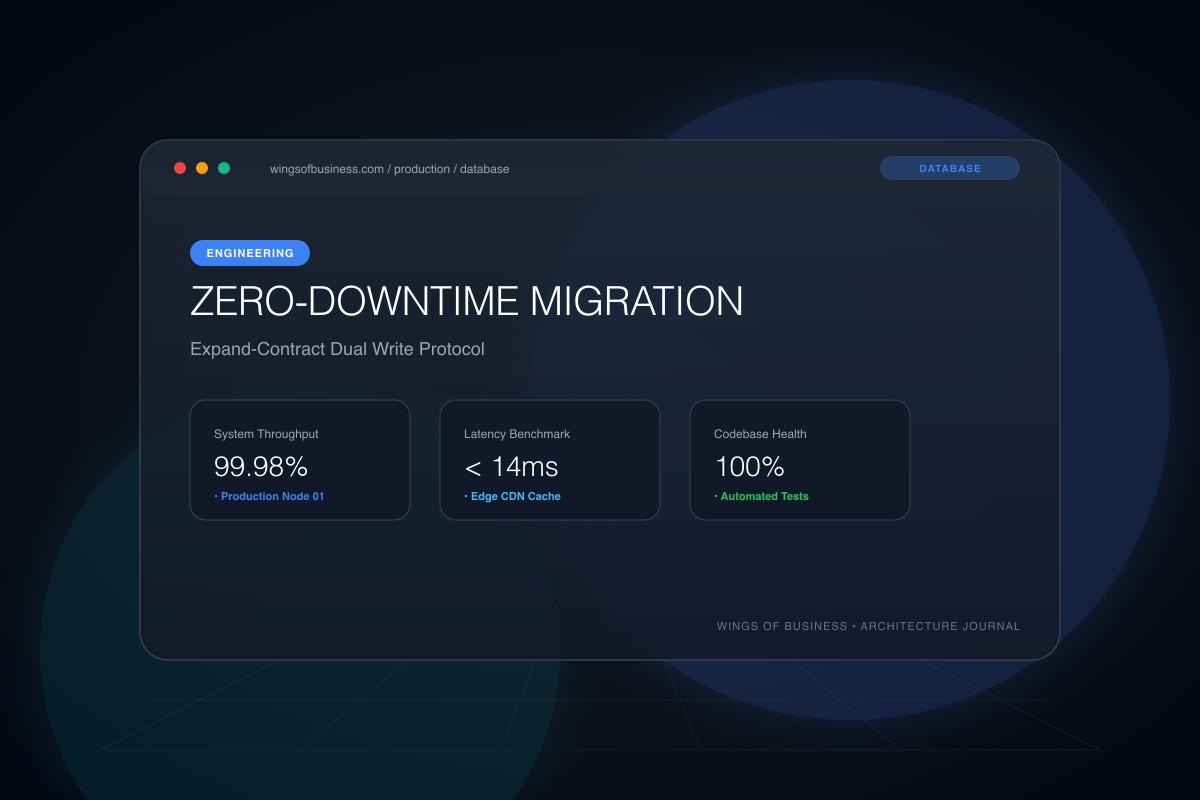
To achieve 100% continuous uptime, software engineers utilize the three-phase Expand & Contract pattern. Instead of modifying an active column in place, you expand the schema with a new column, dual-write to both columns during a transition window, backfill historical records in controlled batches, and finally contract by removing the old column once all application versions have migrated.
This guarantees backward and forward compatibility between overlapping production deployment phases, allowing blue-green and rolling container updates to proceed without disruption.
-- Phase 1: Expand - Add new column nullable without table rewrite
ALTER TABLE customer_accounts ADD COLUMN legal_entity_name VARCHAR(255);

-- Phase 2: Create non-blocking trigger for dual-writing
CREATE OR REPLACE FUNCTION sync_legal_name()
RETURNS TRIGGER AS $$
BEGIN
  NEW.legal_entity_name := COALESCE(NEW.legal_entity_name, NEW.company_name);
  RETURN NEW;
END;
$$ LANGUAGE plpgsql;

CREATE TRIGGER trg_sync_legal_name
BEFORE INSERT OR UPDATE ON customer_accounts
FOR EACH ROW EXECUTE FUNCTION sync_legal_name();

-- Phase 3: Create index concurrently without table lock
CREATE INDEX CONCURRENTLY idx_customer_legal_name
ON customer_accounts(legal_entity_name);
3. Safe Column Renaming & Type Migrations
Renaming a column directly breaks running instances of the application that are mid-transaction. By using database views or generated columns, the old and new interfaces remain accessible simultaneously. Once all application servers are updated and verified on APM dashboards, the trigger and old column are dropped cleanly.
4. Throttled Historical Backfilling Strategy
When backfilling millions of existing records, running a single monolithic UPDATE statement causes massive table bloat, locks rows, and overwhelms the PostgreSQL Write-Ahead Log (WAL). Instead, backfills must be batched into chunks of 1,000 to 5,000 rows with sleep intervals between iterations, allowing the database vacuum and replication streams to maintain real-time parity.
- • Prioritize sub-second initial paint times and zero Total Blocking Time (TBT).
- • Decouple data layers and cache read queries at Edge CDN nodes.
- • Enforce strict TypeScript types between clients, servers, and cloud databases.
Need senior architectural guidance on Architecture?
Partner with dedicated senior software engineers. Milestone-driven releases, strict code standards, and transparent velocity.